JUST ENOUGH RISE
Yes, you can make brownies with self-rising flour.
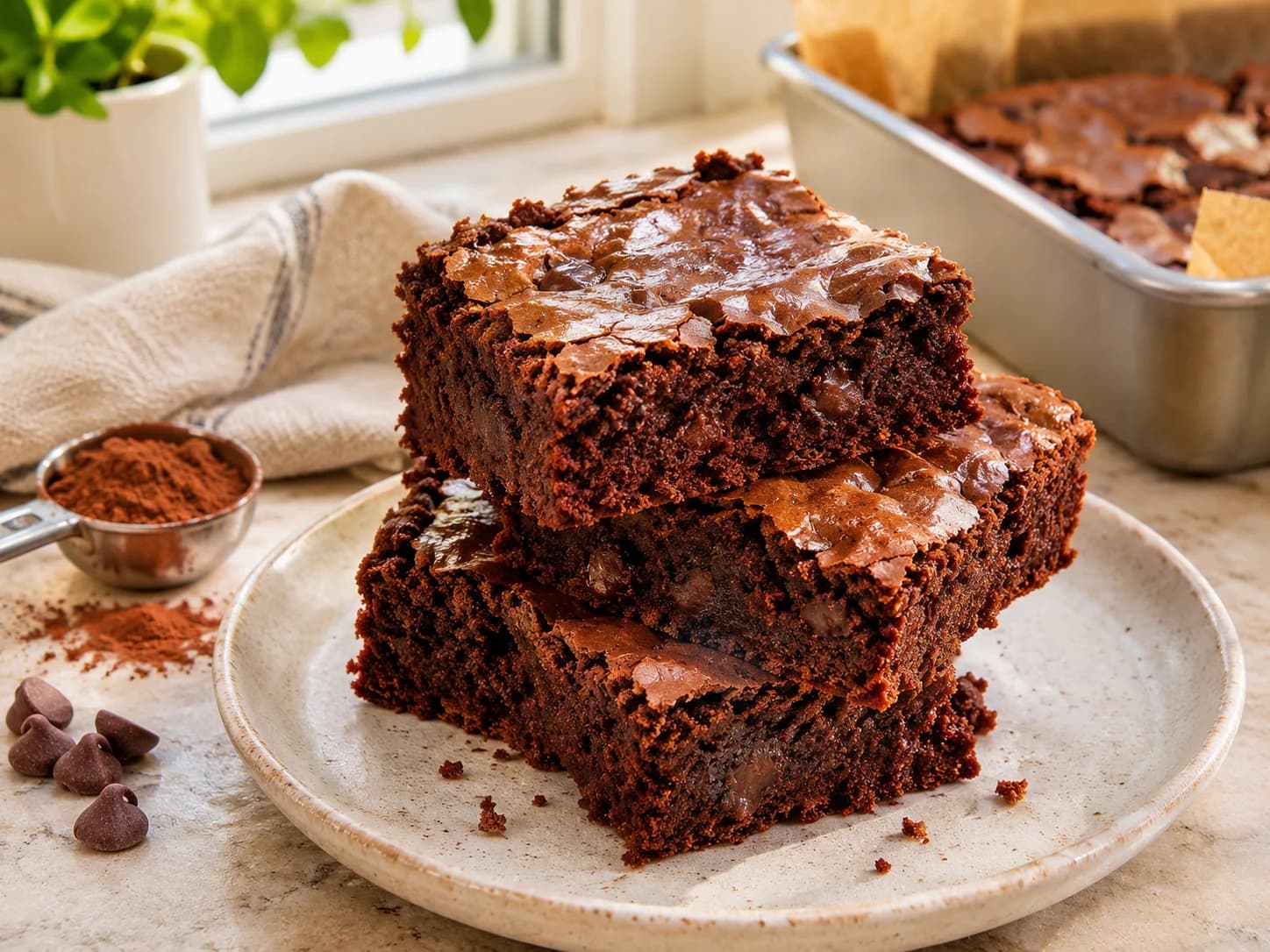
Self-rising flour works in brownies, but it behaves differently from plain flour: it already contains baking powder and salt. That can give the brownies a slightly lighter, softer crumb than a dense, unleavened brownie. The trick is to use a modest amount of flour and stop baking while the center is still moist.
Quick answer: Stir melted butter and sugar together, whisk in the eggs and vanilla, then fold in cocoa and self-rising flour. Spread in an 8-inch square pan and bake at 350°F (175°C) for about 25–30 minutes. Cool before slicing.
You don't need a mixer, extra salt or additional baking powder for this version.
Want a richer brownie with a nutty topping? Try our fudgy pistachio brownies with a creamy pistachio swirl.
If you love chocolate desserts, try our chocolate marble cake with ganache. For a softer pastry-based dessert, make a berry and vanilla croissant cake.
The recipe
Ingredients
Choose your serving size to scale the ingredients.
PICK THE RIGHT PAN
Pan sizes for 8, 16 or 32 brownies
8 squares: Select the half batch and use an 8 × 4-inch loaf pan. Start checking at about 22 minutes; thickness and bake time can vary.
16 squares: Use the full recipe in one 8-inch square metal pan. This is the standard method below.
32 squares: Double the ingredients and divide evenly between two 8-inch square pans. Bake at the same temperature, checking each pan individually and rotating positions if your oven heats unevenly.
Don't pour the doubled batter into one 8-inch pan: the brownies will be too deep to bake evenly using these times.
STEP BY STEP
How to make self-rising flour brownies
Heat the oven and line the pan
Preheat the oven to 350°F (175°C). Line an 8-inch (20 cm) square metal baking pan with parchment, leaving an overhang on two sides. Lightly grease the parchment. For an 8-square half batch, use an 8×4-inch loaf pan; for 32 squares, use two 8-inch square pans.
Mix the butter and sugars
Melt the butter and let it cool until warm rather than hot. Whisk with both sugars for about a minute, until glossy and mostly combined. The sugar may still feel a little grainy.
Whisk in eggs and vanilla
Add the eggs and vanilla. Whisk briskly until smooth, slightly thicker and shiny. This helps make a delicate top crust.
Fold in cocoa and self-rising flour
Sift in the unsweetened cocoa and self-rising flour. Fold with a spatula just until no dry streaks remain. Fold in chocolate chips if using; the batter will be thick. Do not add baking powder or salt: self-rising flour already contains both.
Bake until just set
Spread the batter evenly in the prepared pan. Bake in the center of the oven for about 25–30 minutes, checking at 23 minutes. Look for a set surface and a toothpick with a few moist crumbs, not wet batter; ovens and pan materials vary.
Cool, lift and slice
Cool completely in the pan on a rack, then lift out using the parchment. Use a sharp knife, wiping it between cuts, to divide into 16 squares. For especially neat cuts, chill the cooled slab briefly before slicing.
THE CHOCOLATE TEXTURE
Fudgy or cakey—what should you expect?
These brownies sit between dense fudge brownies and a light chocolate cake. Melted butter, cocoa and sugar help keep the centers rich, while the baking powder already in self-rising flour gives a gentle lift. If you prefer very dense brownies, try a recipe designed for all-purpose flour with no leavener instead.
For a moist center, look for set edges, a slightly glossy top and a toothpick with a few damp crumbs. If the tester is coated in wet batter, bake a little longer and check again. If it comes out bone-dry, the brownies may be overbaked.
WHAT IF YOU DON'T HAVE IT?
How to make a self-rising flour substitute
To make one cup of homemade self-rising flour, whisk 1 cup (120 g) all-purpose flour with 1½ tsp baking powder and ¼ tsp table salt. For the 16-square recipe, measure ¾ cup (90 g) of the finished mixture.
This is a well-established baking substitute, though different flours can absorb liquid differently. Don't also add baking powder or salt separately to the brownie batter.
KITCHEN NOTES
Small details that make better brownies
Warm, not hot, butter: Let the melted butter cool a little before adding eggs so it doesn't start cooking them.
Measure the flour carefully: Weigh 90 g if you can. Scooping flour straight from the bag can pack in too much and leave a dry, bready result.
Stop folding early: Once the flour disappears, put down the spatula. Overmixing can make brownies tougher.
Use a metal pan: Metal heats more predictably than thick glass. If using glass, expect a different bake time and follow the manufacturer's guidance.
Let them cool: Brownies firm as they cool. Cutting while hot can make the centers collapse or stick to the knife.
KEEP THEM FRESH
Storage and freezing
Store fully cooled brownies in a tightly covered container at a cool room temperature for about 3–4 days. In hot or humid conditions, keep them refrigerated and allow them to come to room temperature before serving.
For longer storage, wrap individual squares and freeze for up to 2 months for best quality. Thaw them covered so moisture doesn't condense directly on the chocolate surface.
COMMON QUESTIONS
Self-rising flour brownie FAQs
Can you use self-rising flour instead of plain flour in brownies?
Yes, but it's not always a one-to-one texture match. Self-rising flour contains leavening and salt, so it can produce a lighter brownie. Use a recipe specifically balanced for it, like this one.
Do I need to add baking powder?
No. Self-rising flour already contains baking powder. Extra leavener may make the brownies too puffy or cake-like.
Do I need to add salt?
Not in this recipe. A small amount is already in the self-rising flour. If your brand is unusual, check its ingredient label.
Why did my brownies turn out cakey?
Too much flour, overmixing or baking too long can all give a drier, cakier texture. Self-rising flour also creates more lift than a flour without baking powder.
What size pan should I use?
For 16 squares, an 8-inch square pan. For a half batch, use an 8 × 4-inch loaf pan. For a double batch, use two 8-inch pans.
Can I add nuts or chocolate chips?
Yes. Fold in the optional chocolate chips or ½ cup of chopped walnuts for the regular 16-square batch.
How can I tell when the brownies are done?
The edges should be set and the center should no longer look liquid. A toothpick should have a few moist crumbs, not wet batter.
MORE SWEET IDEAS
Keep something homemade on the counter
For another cozy bake, try our berry and vanilla croissant cake, baked pumpkin donuts, or browse more dessert recipes.